Monocle’s Salone del Mobile newspaper, April 2023
Mario Cucinella might be the busiest man in Milan. He’s the architect behind the city’s newest hospital and museum, while his skyscraper and grand housing developments continue to progress. We talk to him about building the city and his hopes for the Lombardy capital.
See the PDF
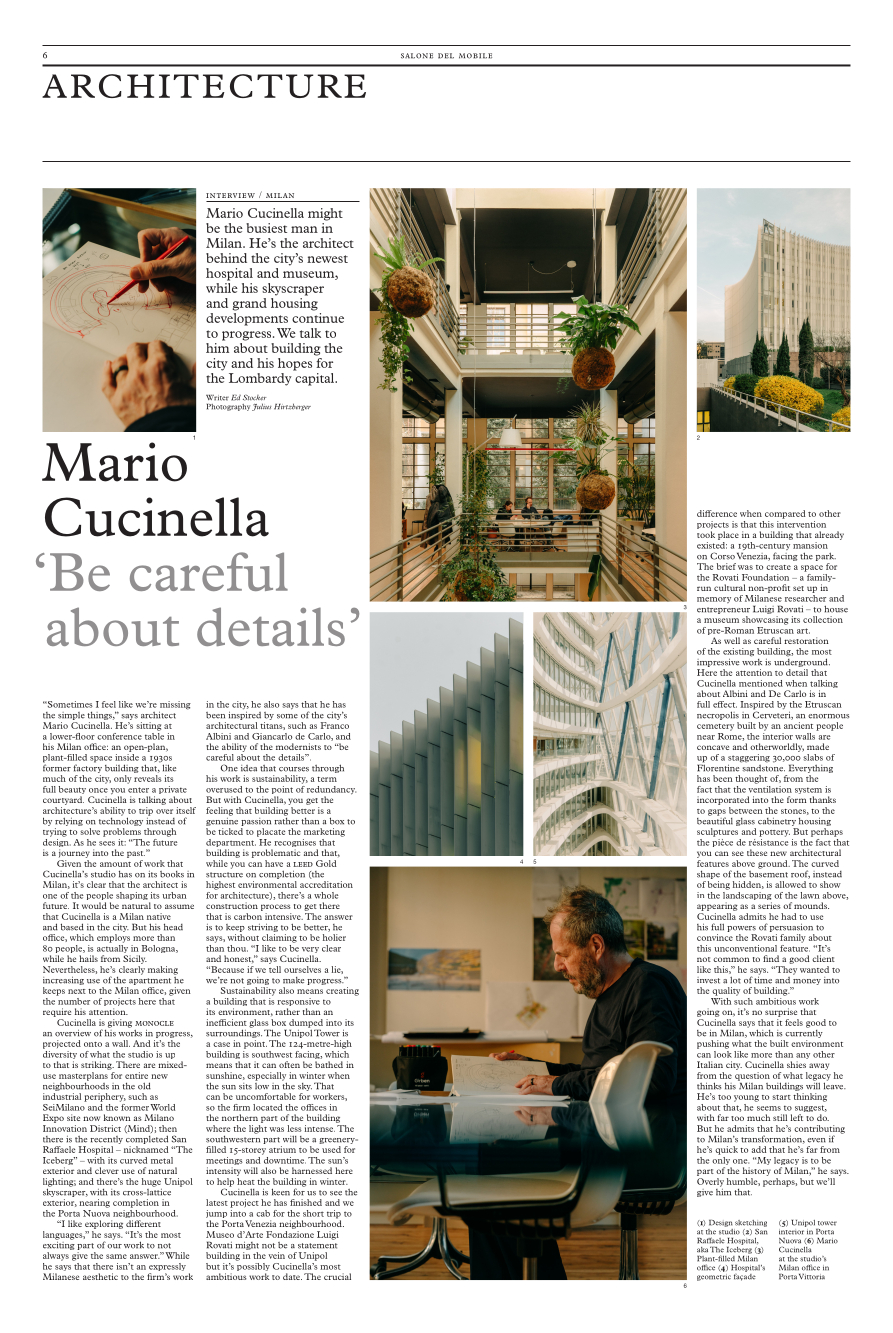
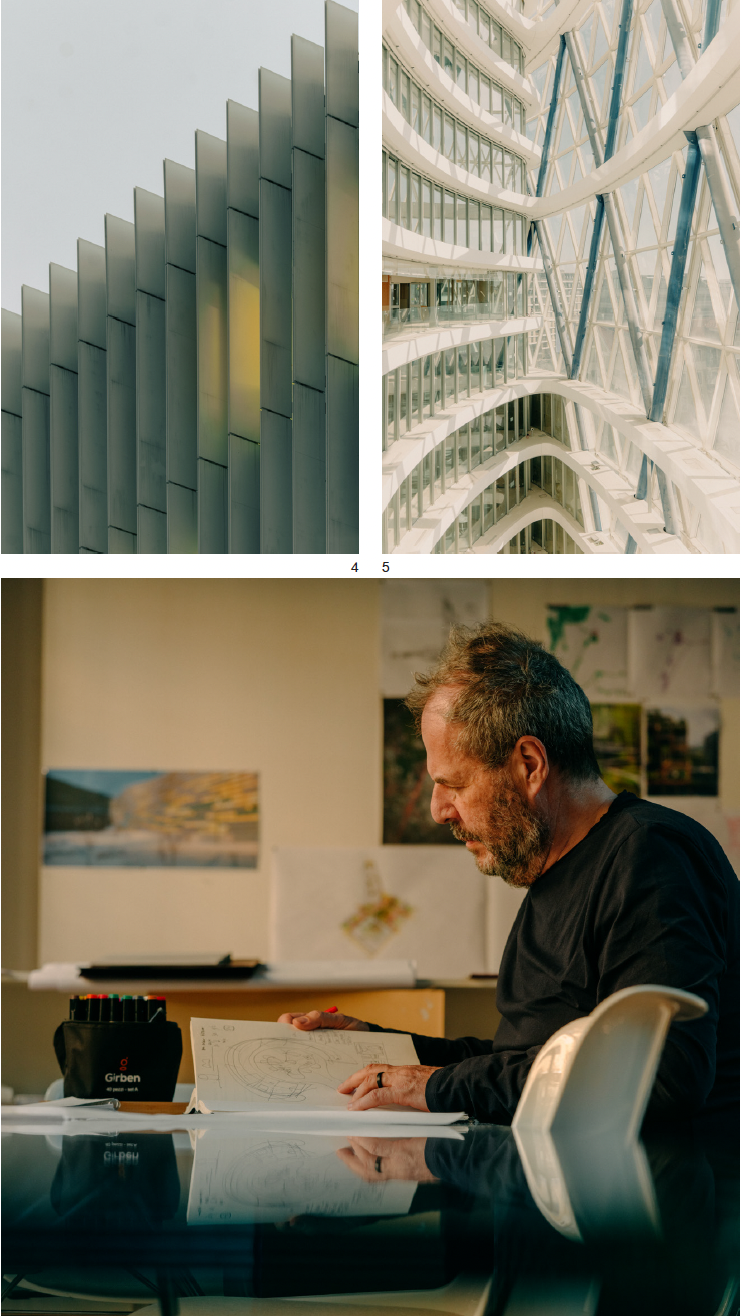
“Sometimes I feel like we’re missing the simple things,” says architect Mario Cucinella. He’s sitting at a lower-floor conference table in his Milan office: an open-plan, plant-filled space inside a 1930s former factory building that, like much of the city, only reveals its full beauty once you enter a private courtyard. Cucinella is talking about architecture’s ability to trip over itself by relying on technology instead of trying to solve problems through design. As he sees it: “The future is a journey into the past.”
Given the amount of work that Cucinella’s studio has on its books in Milan, it’s clear that the architect is one of the people shaping its urban future. It would be natural to assume that Cucinella is a Milan native and based in the city. But his head office, which employs more than 80 people, is actually in Bologna, while he hails from Sicily. Nevertheless, he’s clearly making increasing use of the apartment he keeps next to the Milan office, given the number of projects here that require his attention.
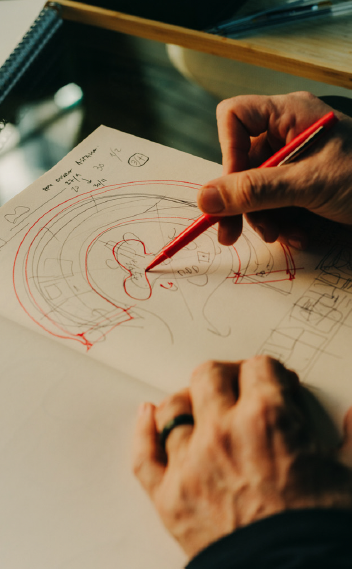
Cucinella is giving monocle an overview of his works in progress, projected onto a wall. And it’s the diversity of what the studio is up to that is striking. There are mixed-use masterplans for entire new neighbourhoods in the old industrial periphery, such as SeiMilano and the former World Expo site now known as Milano Innovation District (Mind); then there is the recently completed San Raffaele Hospital – nicknamed “The Iceberg” – with its curved metal exterior and clever use of natural lighting; and there’s the huge Unipol skyscraper, with its cross-lattice exterior, nearing completion in the Porta Nuova neighbourhood.
“I like exploring different languages,” he says. “It’s the most exciting part of our work to not always give the same answer.” While he says that there isn’t an expressly Milanese aesthetic to the firm’s work in the city, he also says that he has been inspired by some of the city’s architectural titans, such as Franco Albini and Giancarlo de Carlo, and the ability of the modernists to “be careful about the details”.
One idea that courses through his work is sustainability, a term overused to the point of redundancy. But with Cucinella, you get the feeling that building better is a genuine passion rather than a box to be ticked to placate the marketing department. He recognises that building is problematic and that, while you can have a leed Gold structure on completion (the highest environmental accreditation for architecture), there’s a whole construction process to get there that is carbon intensive. The answer is to keep striving to be better, he says, without claiming to be holier than thou. “I like to be very clear and honest,” says Cucinella. “Because if we tell ourselves a lie, we’re not going to make progress.”
Sustainability also means creating a building that is responsive to its environment, rather than an inefficient glass box dumped into its surroundings. The Unipol Tower is a case in point. The 124-metre-high building is southwest facing, which means that it can often be bathed in sunshine, especially in winter when the sun sits low in the sky. That can be uncomfortable for workers, so the firm located the offices in the northern part of the building where the light was less intense. The southwestern part will be a greenery-filled 15-storey atrium to be used for meetings and downtime. The sun’s intensity will also be harnessed here to help heat the building in winter.
Cucinella is keen for us to see the latest project he has finished and we jump into a cab for the short trip to the Porta Venezia neighbourhood. Museo d’Arte Fondazione Luigi Rovati might not be a statement building in the vein of Unipol but it’s possibly Cucinella’s most ambitious work to date. The crucial difference when compared to other projects is that this intervention took place in a building that already existed: a 19th-century mansion on Corso Venezia, facing the park. The brief was to create a space for the Rovati Foundation – a family-run cultural non-profit set up in memory of Milanese researcher and entrepreneur Luigi Rovati – to house a museum showcasing its collection of pre-Roman Etruscan art.
As well as careful restoration of the existing building, the most impressive work is underground. Here the attention to detail that Cucinella mentioned when talking about Albini and De Carlo is in full effect. Inspired by the Etruscan necropolis in Cerveteri, an enormous cemetery built by an ancient people near Rome, the interior walls are concave and otherworldly, made up of a staggering 30,000 slabs of Florentine sandstone. Everything has been thought of, from the fact that the ventilation system is incorporated into the form thanks to gaps between the stones, to the beautiful glass cabinetry housing sculptures and pottery. But perhaps the pièce de résistance is the fact that you can see these new architectural features above ground. The curved shape of the basement roof, instead of being hidden, is allowed to show in the landscaping of the lawn above, appearing as a series of mounds. Cucinella admits he had to use his full powers of persuasion to convince the Rovati family about this unconventional feature. “It’s not common to find a good client like this,” he says. “They wanted to invest a lot of time and money into the quality of building.”
With such ambitious work going on, it’s no surprise that Cucinella says that it feels good to be in Milan, which is currently pushing what the built environment can look like more than any other Italian city. Cucinella shies away from the question of what legacy he thinks his Milan buildings will leave. He’s too young to start thinking about that, he seems to suggest, with far too much still left to do. But he admits that he’s contributing to Milan’s transformation, even if he’s quick to add that he’s far from the only one. “My legacy is to be part of the history of Milan,” he says. Overly humble, perhaps, but we’ll give him that.