Monocle’s Salone del Mobile newspaper, April 2022
David Chipperfield, whose projects grace the streets of Paris, Zürich and Mexico City, on the state of architecture today – and the role of Salone del Mobile.
See the PDF
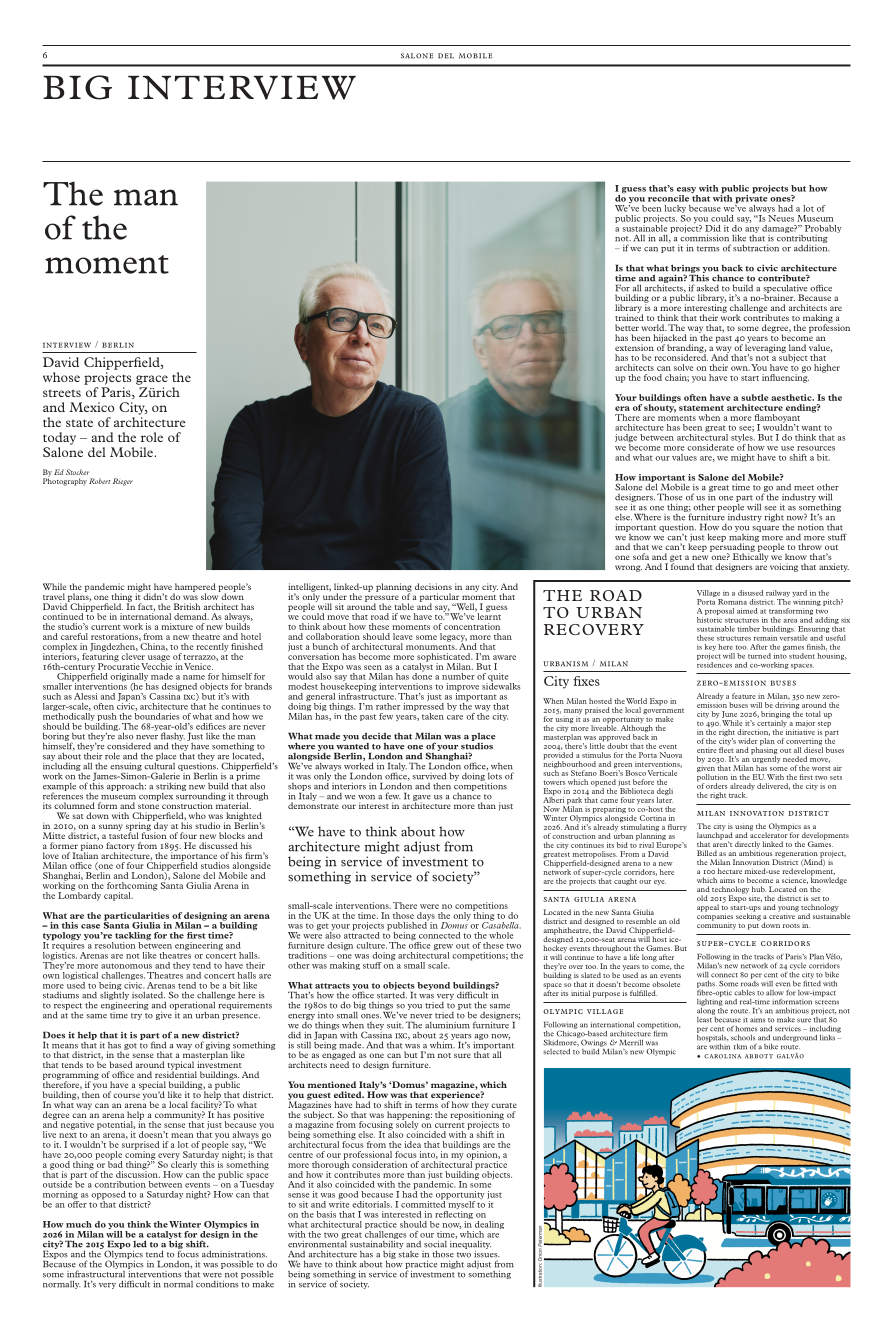
While the pandemic might have hampered people’s travel plans, one thing it didn’t do was slow down David Chipperfield. In fact, the British architect has continued to be in international demand. As always, the studio’s current work is a mixture of new builds and careful restorations, from a new theatre and hotel complex in Jingdezhen, China, to the recently finished interiors, featuring clever usage of terrazzo, at the 16th-century Procuratie Vecchie in Venice.
Chipperfield originally made a name for himself for smaller interventions (he has designed objects for brands such as Alessi and Japan’s Cassina ixc) but it’s with larger-scale, often civic, architecture that he continues to methodically push the boundaries of what and how we should be building. The 68-year-old’s edifices are never boring but they’re also never flashy. Just like the man himself, they’re considered and they have something to say about their role and the place that they are located, including all the ensuing cultural questions. Chipperfield’s work on the James-Simon-Galerie in Berlin is a prime example of this approach: a striking new build that also references the museum complex surrounding it through its columned form and stone construction material.
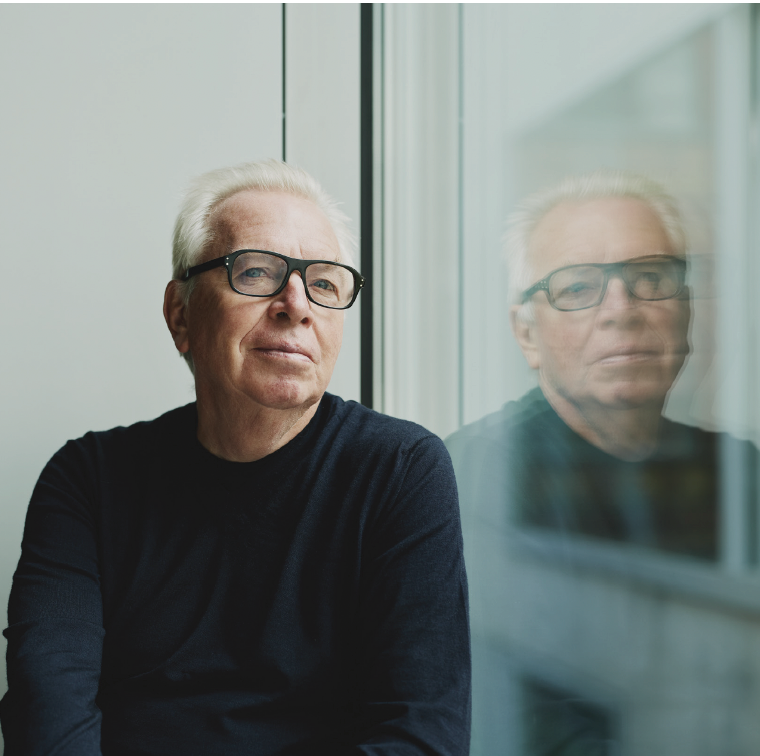
We sat down with Chipperfield, who was knighted in 2010, on a sunny spring day at his studio in Berlin’s Mitte district, a tasteful fusion of four new blocks and a former piano factory from 1895. He discussed his love of Italian architecture, the importance of his firm’s Milan office (one of four Chipperfield studios alongside Shanghai, Berlin and London), Salone del Mobile and working on the forthcoming Santa Giulia Arena in the Lombardy capital.
What are the particularities of designing an arena – in this case Santa Giulia in Milan – a building typology you’re tackling for the first time?
It requires a resolution between engineering and logistics. Arenas are not like theatres or concert halls. They’re more autonomous and they tend to have their own logistical challenges. Theatres and concert halls are more used to being civic. Arenas tend to be a bit like stadiums and slightly isolated. So the challenge here is to respect the engineering and operational requirements and at the same time try to give it an urban presence.
Does it help that it is part of a new district?
It means that it has got to find a way of giving something to that district, in the sense that a masterplan like that tends to be based around typical investment programming of office and residential buildings. And therefore, if you have a special building, a public building, then of course you’d like it to help that district. In what way can an arena be a local facility? To what degree can an arena help a community? It has positive and negative potential, in the sense that just because you live next to an arena, it doesn’t mean that you always go to it. I wouldn’t be surprised if a lot of people say, “We have 20,000 people coming every Saturday night; is that a good thing or bad thing?” So clearly this is something that is part of the discussion. How can the public space outside be a contribution between events – on a Tuesday morning as opposed to a Saturday night? How can that be an offer to that district?
How much do you think the Winter Olympics in 2026 in Milan will be a catalyst for design in the city? The 2015 Expo led to a big shift.
Expos and the Olympics tend to focus administrations. Because of the Olympics in London, it was possible to do some infrastructural interventions that were not possible normally. It’s very difficult in normal conditions to make intelligent, linked-up planning decisions in any city. And it’s only under the pressure of a particular moment that people will sit around the table and say, “Well, I guess we could move that road if we have to.” We’ve learnt to think about how these moments of concentration and collaboration should leave some legacy, more than just a bunch of architectural monuments. And that conversation has become more sophisticated. I’m aware that the Expo was seen as a catalyst in Milan. But I would also say that Milan has done a number of quite modest housekeeping interventions to improve sidewalks and general infrastructure. That’s just as important as doing big things. I’m rather impressed by the way that Milan has, in the past few years, taken care of the city.
What made you decide that Milan was a place where you wanted to have one of your studios alongside Berlin, London and Shanghai?
We’ve always worked in Italy. The London office, when it was only the London office, survived by doing lots of shops and interiors in London and then competitions in Italy – and we won a few. It gave us a chance to demonstrate our interest in architecture more than just small-scale interventions. There were no competitions in the UK at the time. In those days the only thing to do was to get your projects published in Domus or Casabella. We were also attracted to being connected to the whole furniture design culture. The office grew out of these two traditions – one was doing architectural competitions; the other was making stuff on a small scale.
What attracts you to objects beyond buildings?
That’s how the office started. It was very difficult in the 1980s to do big things so you tried to put the same energy into small ones. We’ve never tried to be designers; we do things when they suit. The aluminium furniture I did in Japan with Cassina ixc, about 25 years ago now, is still being made. And that was a whim. It’s important to be as engaged as one can but I’m not sure that all architects need to design furniture.
You mentioned Italy’s ‘Domus’ magazine, which you guest edited. How was that experience?
Magazines have had to shift in terms of how they curate the subject. So that was happening: the repositioning of a magazine from focusing solely on current projects to being something else. It also coincided with a shift in architectural focus from the idea that buildings are the centre of our professional focus into, in my opinion, a more thorough consideration of architectural practice and how it contributes more than just building objects. And it also coincided with the pandemic. In some sense it was good because I had the opportunity just to sit and write editorials. I committed myself to it on the basis that I was interested in reflecting on what architectural practice should be now, in dealing with the two great challenges of our time, which are environmental sustainability and social inequality. And architecture has a big stake in those two issues. We have to think about how practice might adjust from being something in service of investment to something in service of society.
I guess that’s easy with public projects but how do you reconcile that with private ones?
We’ve been lucky because we’ve always had a lot of public projects. So you could say, “Is Neues Museum a sustainable project? Did it do any damage?” Probably not. All in all, a commission like that is contributing – if we can put it in terms of subtraction or addition.
Is that what brings you back to civic architecture time and again? This chance to contribute?
For all architects, if asked to build a speculative office building or a public library, it’s a no-brainer. Because a library is a more interesting challenge and architects are trained to think that their work contributes to making a better world. The way that, to some degree, the profession has been hijacked in the past 40 years to become an extension of branding, a way of leveraging land value, has to be reconsidered. And that’s not a subject that architects can solve on their own. You have to go higher up the food chain; you have to start influencing.
Your buildings often have a subtle aesthetic. Is the era of shouty, statement architecture ending?
There are moments when a more flamboyant architecture has been great to see; I wouldn’t want to judge between architectural styles. But I do think that as we become more considerate of how we use resources and what our values are, we might have to shift a bit.
How important is Salone del Mobile?
Salone del Mobile is a great time to go and meet other designers. Those of us in one part of the industry will see it as one thing; other people will see it as something else. Where is the furniture industry right now? It’s an important question. How do you square the notion that we know we can’t just keep making more and more stuff and that we can’t keep persuading people to throw out one sofa and get a new one? Ethically we know that’s wrong. And I found that designers are voicing that anxiety.